

Here you can find an archive of all my previous projects, all of which were previously posted on the home page. Once I have a new project, I update the home page and put older projects here. Each card represents what was previously under the Recent Projects header and are all dated with the day that the project was posted.
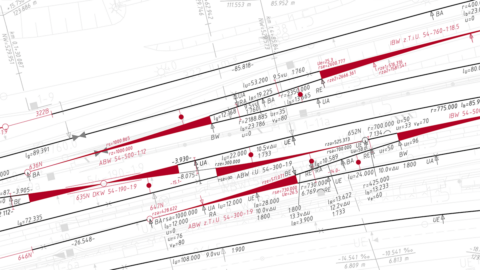 My most recent project at my University revolved around planning a "Strecke" or line that runs between two other pre-existing lines, while also connecting two residentail areas in the process. The ~15km double track and electrified line was created with the help of CAD overlayed with the "Programmsystem für Verkehrs- und Infrastrukturplanung" (ProVI). As this was a group project I unfortunately can not share pictures/screenshots, as these are protected under privacy laws. In my opinion the program feels generally unpolished, and helpful information is scarce, if not impossible to find. Once you do a bit of experimentation, things go much smoother. Which was helpful whenever it turned out I needed to redo some of the planning :).
Each group also had to submit a report detailing the planning process, issues, etc. Our group used LaTex for the report, which may or may not have given me some motivation to learn to code in HTML and CSS, as creating your own personal format and design intrigues me quite a lot.
I recently had a work trip to Hamburg, more specifically, to the sections of track under the managment of the Hamburg Port Authority. The task revolved around measuring the "Schienenrauheit", or how smooth the rails are. Hamburg itself is a very nice city, definitely very different than Berlin. I got to ride the ferry, and food was cheap. Almost didn't make it home because the trains got cancelled due to damage to the caternary on the line back to Berlin. Mine was magically brought back from the dead (the DB found a detour). It even made it without more than a minute of delay, anyone who knows the DB is well aware of how rare that is haha.
Measuring the Schienenrauheit is done by guiding a sort of sensor across the rail's surface. The device returns a graph which magnifies and visualizes the differences in height over distance. This helps us decide if the rails need to be "polished" or not. A rough rail surface can cause excessive vibrations which resonate through the rails and contribute to noise, and piss off the Nimbys. So its better to reduce noise in any way possible.
